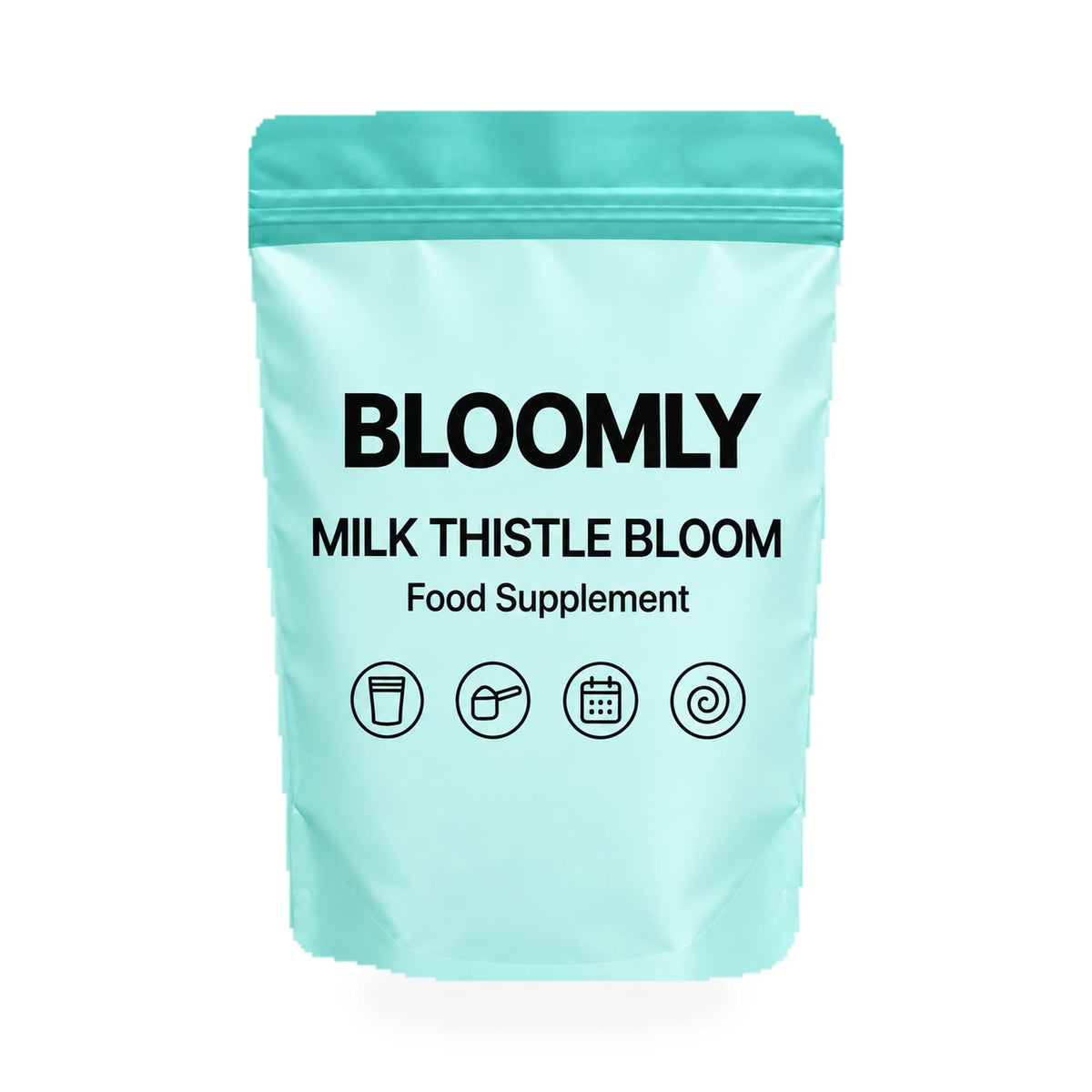
Milk Thistle Bloom
£7.99
Food supplement · 120 tablets
Milk Thistle Bloom is a food supplement from BLOOMLY. Full ingredients, nutrition information and directions are on this page.
Milk Thistle Bloom
What Milk Thistle Bloom Is
Milk Thistle Bloom is a milk thistle food supplement. Milk thistle is one of the longest-established botanicals on a supplement shelf, and also one where the labels vary enough to be genuinely confusing — so this page is mostly about how to read them.
What Milk Thistle Is
Milk thistle is the common name for Silybum marianum, a flowering plant in the daisy family. It is native to the Mediterranean and has spread widely; in much of the world it grows as a common roadside weed, tall and spiny with a purple flower head.
The name comes from the white veining on its leaves. The part used in supplements is not the leaf or the flower but the seed, which is why a well-specified product will say "milk thistle seed extract" rather than simply "milk thistle".
Silymarin — The Word That Does The Work On The Label
The compounds of interest in milk thistle seed are a group collectively called silymarin, which includes several related substances, the best known being silybin.
Silymarin is the reason milk thistle labels look the way they do. Because these compounds make up only a portion of the seed, milk thistle is usually sold as a standardised extract — meaning the extract has been produced so that silymarin makes up a stated percentage of it, commonly written as something like "standardised to 80% silymarin".
This has a direct practical consequence when comparing two products:
- A product listing a large milligram figure of milk thistle seed is describing raw plant material.
- A product listing a smaller milligram figure of extract standardised to 80% silymarin is describing something far more concentrated.
The bigger number is not the stronger product. Without the standardisation figure, a milligram number on a milk thistle pack tells you almost nothing.
Extract Ratios, And Why Two Numbers Are Better Than One
Alongside standardisation you will often see an extract ratio, written as something like 30:1 or 80:1. That ratio states how much raw seed was concentrated into a given weight of extract.
Between them, the ratio and the standardisation percentage are what make two milk thistle products comparable. A label that gives both is telling you something. A label that gives neither is telling you a number.
Why We Do Not Tell You What It Does
Milk thistle is marketed with promises attached to particular organs. We do not make them.
In the United Kingdom a supplement may only carry a health claim that appears on the official register of authorised claims. There is no authorised claim for milk thistle or for silymarin. That is true for every brand selling it in this country.
So this page explains the plant, the part used, the compound group the label refers to, and how to read a standardisation figure. That is genuinely useful when choosing between products — which is more than a promise would be.
How It Fits Into Your Routine
Milk thistle is taken as a daily habit rather than occasionally, and is usually anchored to a meal.
What You Get In Each Pack
A single pack, a 2 pack and a 4 pack. Identical product in each; only the quantity changes. Prices are shown on this page before you add anything to your basket.
Who It's For
Adults who want a milk thistle supplement and would rather be shown how to compare extracts than be told what an extract will do.
Milk thistle is in the daisy family, which also includes ragweed, chrysanthemum and marigold — if you have an allergy to plants in that family, this is one to avoid. It is also among the botanicals commonly mentioned in relation to medication interactions. If you take prescribed medication, are pregnant, are breastfeeding or are under medical supervision, speak to your doctor before taking it.
Questions, Answered
What plant does milk thistle come from?
Silybum marianum, a flowering plant in the daisy family, native to the Mediterranean.
Which part of the plant is used?
The seed. A well-specified label says "milk thistle seed extract" rather than just "milk thistle".
What is silymarin?
The collective name for a group of related compounds found in milk thistle seed, the best known of which is silybin. It is what standardised milk thistle extracts are standardised to.
What does "standardised to 80% silymarin" mean?
That silymarin makes up that stated proportion of the extract. It is the figure that makes two extracts comparable.
What does a 30:1 extract ratio mean?
That a stated weight of raw seed was concentrated down to a smaller weight of extract.
Why is a bigger milligram number not necessarily stronger?
Because a large figure often describes raw seed material, while a smaller figure may describe a concentrated standardised extract. The two are not comparable without the standardisation.
Is milk thistle related to any common allergens?
It is in the daisy family, alongside ragweed, chrysanthemum and marigold. If you are allergic to plants in that family, avoid it.
Should I check with my doctor before taking it?
Yes, if you take prescribed medication, are pregnant, are breastfeeding or are under medical supervision.
Important Information
Storage: Store in a cool, dry place. Store out of the reach of young children.
Warnings: Do not exceed the recommended daily dose. Food supplements should not be used as a substitute for a varied and balanced diet and a healthy lifestyle. Store out of the reach of young children. If you are pregnant, breastfeeding, taking medication or under medical supervision, consult your doctor before use.
Ingredients
Plant-Based Binding Agent: Microcrystalline Cellulose, Artichoke Leaf Extract (Cynara Scolymus), Milk Thistle Extract (Silybum Marianum), Di Calcium Phosphate, Dandelion Leaf Extract (Taraxacum Officinale), Plant-Based Anti-Caking Agent: Magnesium Stearate.
Allergens
Always check the allergen statement printed on the pack before use.
Nutrition information
- Pack size: 120 tablets per pack
- Servings per pack: 60
- Serving size: 2 tablets
| Per serving (2 tablets) | Amount | %NRV |
|---|---|---|
| Milk Thistle Extract 4:1 (80% Silymarin) | 100 mg | ** |
| — Equivalent Milk Thistle Powder | 4000 mg | ** |
| Artichoke Extract 14:1 | 114.3 mg | ** |
| — Equivalent Artichoke Powder | 1600 mg | ** |
| Dandelion Leaf Extract 4:1 | 100 mg | ** |
| — Equivalent Dandelion Leaf Powder | 400 mg | ** |
%NRV = percentage of the Nutrient Reference Value. ** NRV not established.
How to Use
Take 2 tablets daily with a glass of water. Not intended for use by persons under the age of 18.
FAQ
What is Milk Thistle Bloom?
Milk Thistle Bloom is a food supplement from BLOOMLY.
How do I take it?
Full directions are printed on the pack. Please do not exceed the recommended daily dose.
When should I take it?
Full directions are printed on the pack.
What ingredients are included?
The full ingredient list is printed on the pack.
Can I use it with other Bloomly products?
Please check the label of each product and never exceed the recommended daily dose of any of them. If you are taking medication, speak to your doctor first.
How long is UK delivery?
We deliver across the UK. Available delivery options and costs are shown at checkout before you pay.
What is the returns policy?
You can find full details in our Returns Policy.
Reviews
No reviews yet. Tried Milk Thistle Bloom? Be the first to share your experience.